Which Combine Parts Are Most Commonly Replaced During Harvest Season?
Plan combine spares before harvest with a practical checklist for bearings, belts, chains, sprockets, knife parts, seals, and drives.
Quick Answer
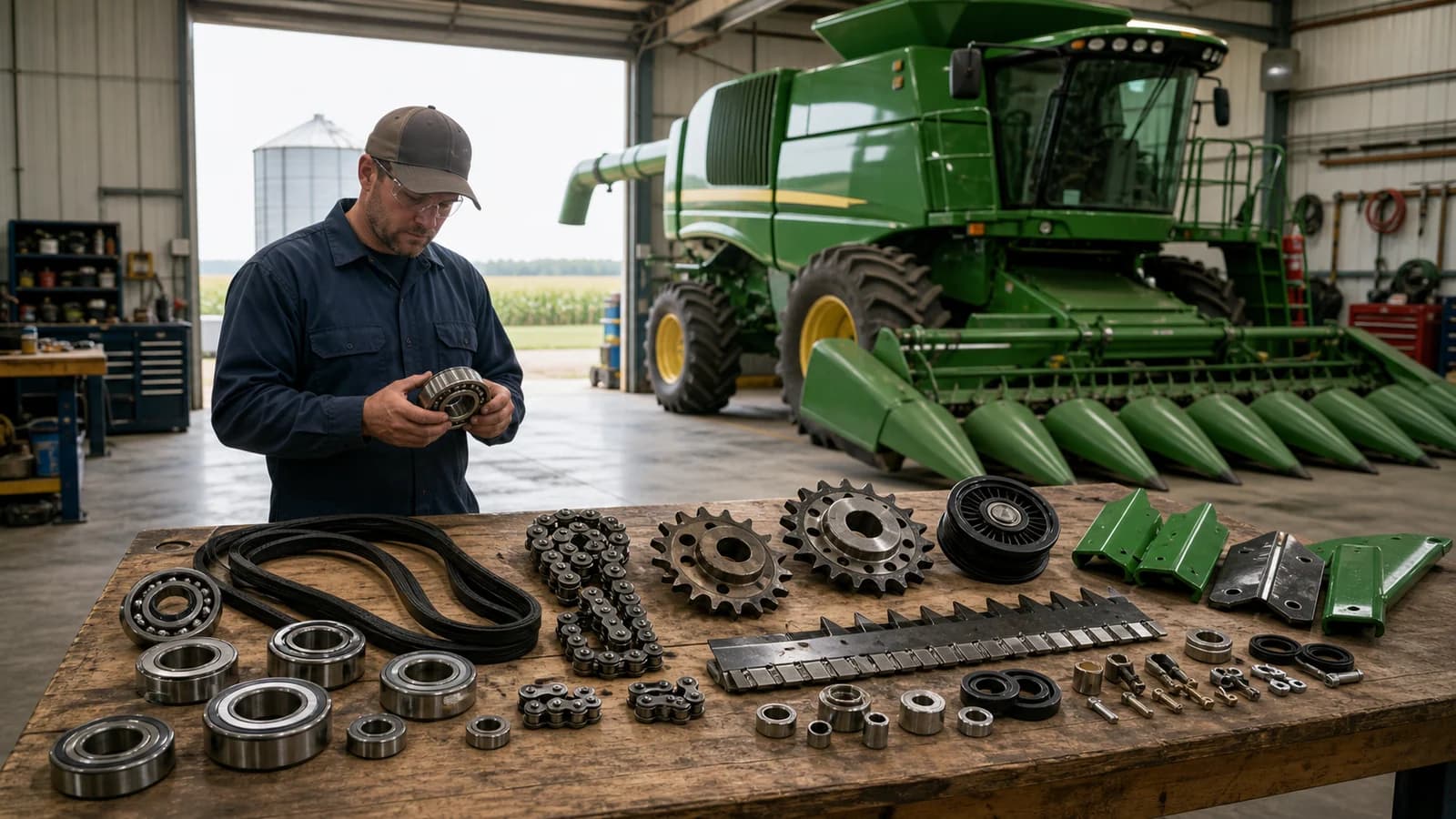
The combine parts most likely to need attention are concentrated in high-wear and high-motion areas:
- knife sections and guards;
- bearings;
- belts;
- chains;
- sprockets and idlers;
- feederhouse components;
- clean-grain and tailings elevator components;
- auger and reel fingers;
- threshing and separating wear parts;
- bushings, seals, and smaller drive components.
The smartest strategy is not necessarily to keep every large component in stock.
It is to identify the relatively small parts that can stop a very large machine.
Why Do Combines Consume So Many Wear Parts?
A combine is effectively several machines operating at once.
It must:
- cut or gather the crop;
- feed material into the machine;
- thresh it;
- separate grain;
- clean grain;
- move grain into the tank;
- unload it;
- process or discharge residue.
All of that happens in dust, vibration, crop residue, variable moisture, and long operating hours.
Wear is inevitable.
John Deere's own grain-harvesting inspection guidance tells operators to examine belts, chains, sprockets, bearings, knife sections, guards, feederhouse chains and slats, auger flighting and fingers, concaves, rotor elements, rasp bars, separation grates, sieves and chaffers.
That list gives a useful map of where downtime often begins.
1. Bearings
If you asked experienced combine owners to name a part they never completely trust, bearings would be high on the list.
They operate throughout the machine:
- header;
- feederhouse;
- elevators;
- augers;
- shafts;
- cleaning system;
- straw chopper;
- drive assemblies.
A failing bearing can start as heat, noise, vibration, looseness, or rough rotation.
Ignored long enough, it can damage:
- shafts;
- housings;
- belts;
- sprockets;
- nearby sheet metal.
Operators discussing older combines often identify bearings as one of their recurring failures, and John Deere specifically recommends checking them for roughness during inspection.
Good spare candidates
Common, machine-specific bearings and bearing assemblies can be sensible parts to keep available when they are relatively inexpensive and easy to store.
2. Belts
Combines depend on multiple belt-driven systems.
Belts should be inspected for:
- cracking;
- glazing;
- fraying;
- heat damage;
- missing material;
- poor tension.
John Deere's pre-harvest guidance specifically calls for inspecting belts for cracking, glazing, fraying, and heat spots.
A damaged belt rarely improves with another day of harvest.
If a belt is clearly deteriorating before the crop is ready, replacement is normally much easier than waiting for it to fail in the field.
3. Chains and Connecting Links
Chains live in dirty, abrasive conditions and can suffer from:
- elongation;
- worn rollers;
- stiff links;
- damaged links;
- poor alignment;
- improper tension.
The chain should be evaluated together with its sprockets.
A stretched chain running on a badly worn sprocket is not a healthy drive system just because one new component was installed.
High-wear agricultural parts suppliers routinely stock roller-chain links, feederhouse chains, clean-grain elevator chains, and associated sprockets because these are normal service categories.
4. Sprockets and Idlers
A small sprocket can shut down a very expensive combine.
That is one reason these components deserve attention before harvest.
Look for:
- hooked teeth;
- visibly thin teeth;
- wobble;
- damaged hubs;
- bearing play;
- poor chain alignment.
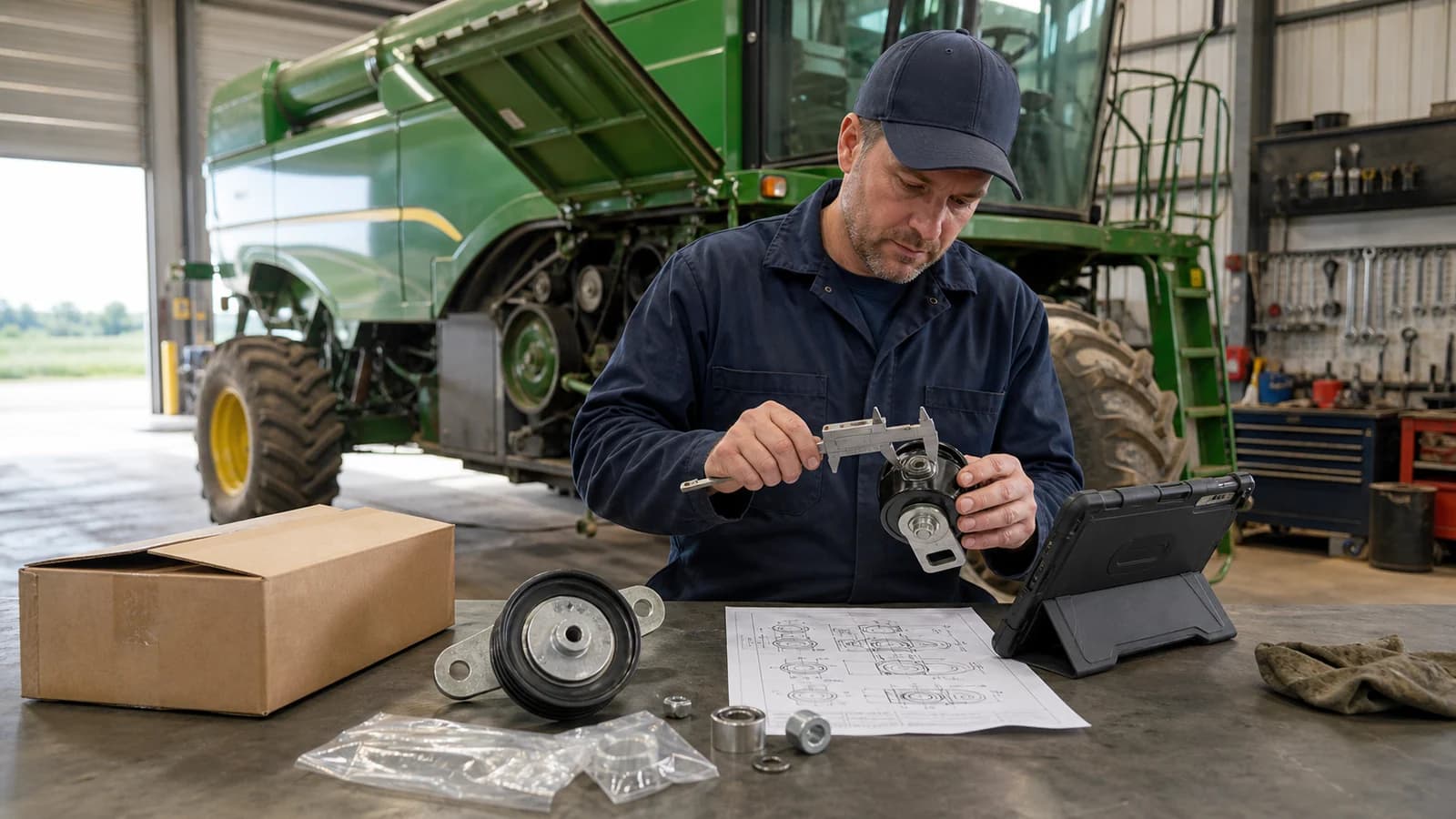
Sprockets are particularly good examples of why OEM number and dimensions both matter.
A visually similar sprocket can have a different:
- tooth count;
- bore;
- offset;
- keyway;
- chain size.
Do not order from the photograph alone.
5. Knife Sections
On grain platforms and cutterbars, knife sections work directly against the crop and can be damaged by wear, rocks, foreign objects, or impact.
Dull or damaged cutting components can contribute to poor cutting performance.
Inspect:
- broken sections;
- rounded cutting edges;
- loose hardware;
- damaged knife heads;
- excessive play.
Knife sections are among the classic harvest wear items that are often worth keeping on hand.
They are relatively small.
They are consumable.
And when one breaks, the machine still needs to cut.
6. Guards and Hold-Down Components
Knife sections do not work alone.
Guards and related hold-down components affect cutterbar performance.
Watch for:
- broken guards;
- bent guards;
- excessive clearance;
- wear;
- loose mounting hardware.
A new knife operating against badly worn guards may still perform poorly.
Evaluate the cutting system as an assembly.
7. Reel and Auger Fingers
Reel fingers and auger fingers are exposed to crop material and accidental impacts.
They can become:
- bent;
- broken;
- missing;
- excessively worn.
Because many are relatively small and straightforward to replace, they can make practical spare inventory for some operations.
Aftermarket combine suppliers routinely offer reel fingers, auger fingers, finger guides and related components for John Deere and Case IH applications.
8. Feederhouse Chains and Slats
The feederhouse is one of the critical transitions in crop flow.
Components commonly inspected include:
- feederhouse chain;
- slats;
- sprockets;
- drums;
- shafts;
- bearings;
- related drive parts.
Major aftermarket suppliers maintain dedicated feederhouse categories covering chains, bottoms, drive sprockets, drums, shafts, and other components across John Deere, Case IH, New Holland and Massey Ferguson machines.
A feederhouse problem can stop crop flow completely.
9. Clean-Grain and Tailings Elevator Components
Once grain is separated and cleaned, it still has to move.
Elevator systems typically involve:
- chain;
- paddles;
- sprockets;
- bearings;
- shafts;
- housings.
These components live in continuous motion during harvest.
Check chains for stretch and paddles for damage.
Check sprockets for wear.
Listen to bearings.
Small problems in grain handling can become large problems quickly.
10. Pulleys and Tensioners
Pulleys and tensioners may receive less attention than belts, but they directly affect belt life.
Check for:
- bearing noise;
- wobble;
- damaged grooves;
- incorrect alignment;
- weak tension;
- excessive wear.
A new belt installed on a failing idler may not remain new for very long.
11. Bushings, Sleeves, Seals and Small Hardware
These parts are inexpensive enough to ignore—until you need one.
Examples include:
- bushings;
- sleeves;
- collars;
- seals;
- retainers;
- clips;
- keys;
- small couplers.
Individually, they may be low-value components.
Operationally, they can be critical.
This is one reason a good pre-harvest spare kit should not consist only of expensive parts.
12. Threshing and Separating Wear Components
Farther inside the combine, wear can affect:
- rasp bars;
- threshing elements;
- rotor bars;
- concaves;
- grates;
- separator components.
John Deere includes concaves, rotor elements, rasp bars, separation grates, sieves, chaffers and shoe-frame areas among systems to inspect.
These parts are generally larger and more expensive than a bearing or sprocket, so operators are less likely to keep every version on the shelf.
The important point is to inspect them early.
Discovering major threshing wear the night before harvest is a procurement problem.
Discovering it several weeks earlier is maintenance.
13. Sieves, Chaffers and Cleaning-System Parts
Poor cleaning performance is not always a settings problem.
Physical wear or damage can affect the cleaning system.
Inspect:
- sieve condition;
- chaffer condition;
- frames;
- linkage;
- bushings;
- drive components.
Loose or worn components may create vibration and additional damage.
What Are the Best Combine Parts to Keep as Emergency Spares?
The answer depends on the machine, but good candidates generally share four characteristics:
1. They have a realistic chance of wearing or failing.
2. Failure can stop or seriously reduce harvesting.
3. They are relatively inexpensive compared with downtime.
4. They are easy to store.
That often makes parts such as these worth considering:
- selected bearings;
- knife sections;
- guards;
- chain connecting links;
- small sprockets;
- idlers;
- bushings;
- seals;
- auger fingers;
- reel fingers;
- selected sensors or switches;
- critical hardware.
You do not need a second combine sitting in the parts shed.
You need the right small parts for your machine.
What Should I Inspect Before Harvest?
A practical priority list is:
Cutting system
Knife sections, guards, hold-downs, reel components.
Feeding
Feederhouse chain, slats, sprockets, drum and bearings.
Drives
Belts, chains, bearings, pulleys, tensioners.
Threshing and separation
Rotor/threshing elements, concaves and grates.
Grain handling
Elevator chains, paddles, augers, sprockets and bearings.
Cleaning system
Sieve, chaffer, frames and drive components.
Hydraulic and electrical
Leaks, hoses, wiring, sensors and warning systems.
This closely mirrors the systems manufacturers themselves recommend inspecting before and during the harvesting season.
Replace Now or Keep as a Spare?
| Condition | Recommended Action |
|---|---|
| Broken | Replace |
| Cracked or severely damaged | Replace |
| Bearing rough or loose | Investigate/replace |
| Belt badly cracked or frayed | Replace |
| Sprocket heavily hooked | Replace |
| Chain badly stretched | Replace |
| Part worn but stable | Plan replacement |
| Good part with known failure history | Consider keeping spare |
| Large expensive component in good condition | Inspect rather than stock blindly |
The goal is not to replace parts unnecessarily.
It is to avoid predictable failures during your most time-sensitive weeks.
Why OEM Numbers Matter for Emergency Spares
Imagine needing a bearing at 9:00 p.m. during corn harvest.
That is not the ideal time to begin researching what fits your machine.
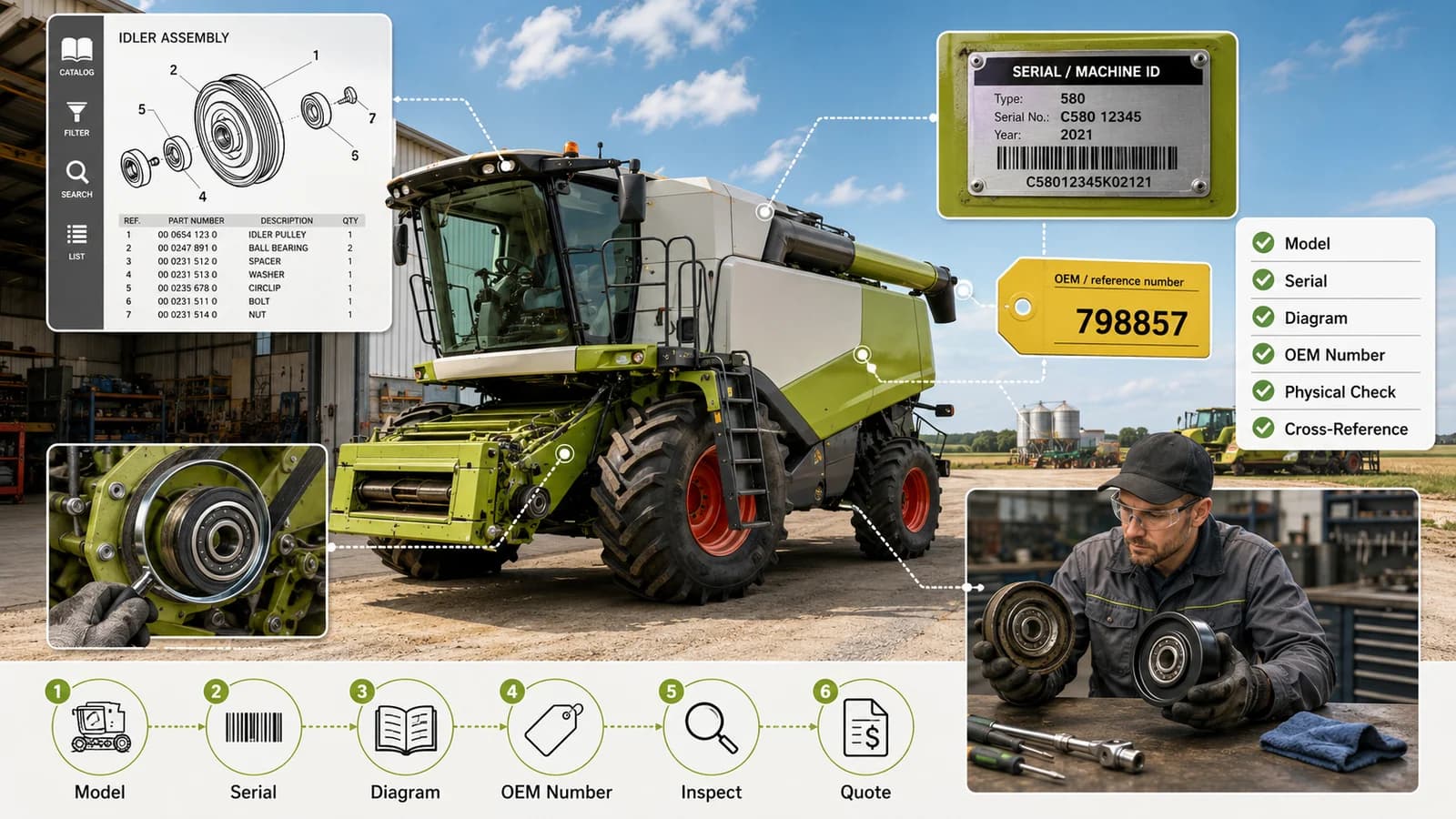
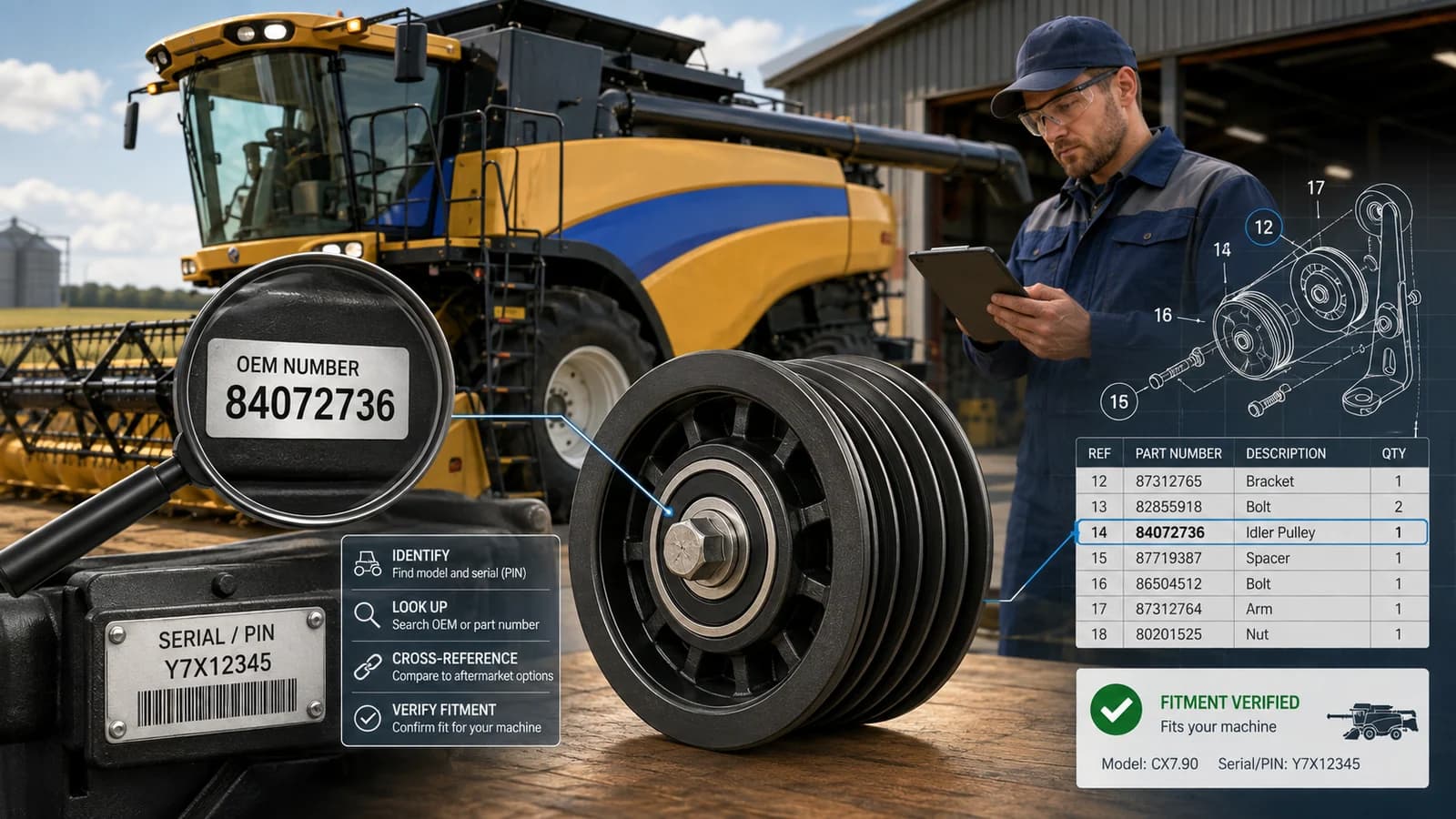
Before harvest, record OEM numbers for selected critical wear components.
You can create a simple machine-specific list:
Create a machine-specific record before harvest:
| Field | What to record |
|---|---|
| Machine | Brand, complete model, and serial or PIN |
| Component | Exact assembly location and part name |
| Reference | Verified OEM number and any documented supersession |
| Spare level | Quantity selected for your acreage, lead time, and failure history |
| Evidence | Diagram position, dimensions, and a clear photo |
Now a failure becomes a repair job rather than a research project.
Frequently Asked Questions
What parts fail most often on a combine?
There is no universal ranking because crop, hours, machine design, maintenance and operating conditions differ. Bearings, belts, chains, sprockets, cutting components and other high-motion wear parts deserve regular inspection.
What combine parts should I keep on hand during harvest?
Prioritize smaller, relatively inexpensive parts capable of creating downtime: common bearings, knife sections, guards, chain links, selected sprockets, idlers, bushings and other machine-specific wear items.
Should I replace bearings before they fail?
Not automatically. Inspect for roughness, heat, noise, looseness and other signs of deterioration and follow the machine manufacturer's maintenance guidance.
Are knife sections and guards considered wear parts?
Yes. They operate directly in the crop-cutting system and should be regularly inspected for wear or damage.
Should I buy emergency parts by model or OEM number?
Whenever possible, record the OEM reference as well as the machine model and serial number. That makes replacement identification faster and more accurate.
When should I order major threshing components?
Inspect well before harvest. Larger components such as concaves and threshing elements are better handled as planned maintenance than as emergency orders.
Continue your parts research
Plan drive-system spares with the replacement belt guide for John Deere combines.
Include contamination-control items from the air and fuel filter maintenance guide.
For fluid-power components, use the hydraulic pump maintenance guide.
Send your machine-specific spare list and OEM references in a replacement-part quote request.
Bottom Line
The most important combine spare is not necessarily the most expensive part.
It is often the small component that can stop the entire machine.
Before harvest, pay particular attention to:
**Bearings
Belts
Chains
Sprockets
Idlers
Knife Sections
Guards
Feederhouse Components
Elevator Components
Auger and Reel Fingers
Bushings and Seals**
Inspect the larger threshing, separating, and cleaning components early enough to order them without panic.
And for the small critical parts you know your machine may need, record the OEM numbers before harvest starts.
When the crop is ready, the best parts lookup is the one you already completed.
Official references
- John Deere Agriculture Quick Reference Guides
- John Deere Combine Parts and Belts Guide
- Case IH Operator's Manuals
Manufacturer and model names are trademarks of their respective owners. FieldFit Parts is not affiliated with or endorsed by John Deere, Case IH, New Holland, or CLAAS. Inspection and replacement decisions must follow the current operator or service manual for the specific machine. OEM numbers are used for identification and compatibility reference only.
Continue to the catalog
Related Combine Parts Catalogs
Move from lookup guidance to published brand-specific parts. Search by the complete OEM or reference number and confirm the machine details before ordering.
John Deere Combine Parts
Browse published John Deere combine replacement parts by OEM or reference number, then verify model and serial details.
Browse partsPublished catalogCase IH Combine Parts
Browse published Case IH combine replacement parts by OEM or reference number, then verify model and serial details.
Browse partsPublished catalogCLAAS Combine Parts
Browse published CLAAS combine replacement parts by OEM or reference number, then verify model and serial details.
Browse partsPublished catalogNew Holland Combine Parts
Browse published New Holland combine replacement parts by OEM or reference number, then verify model and serial details.
Browse partsRelated Parts
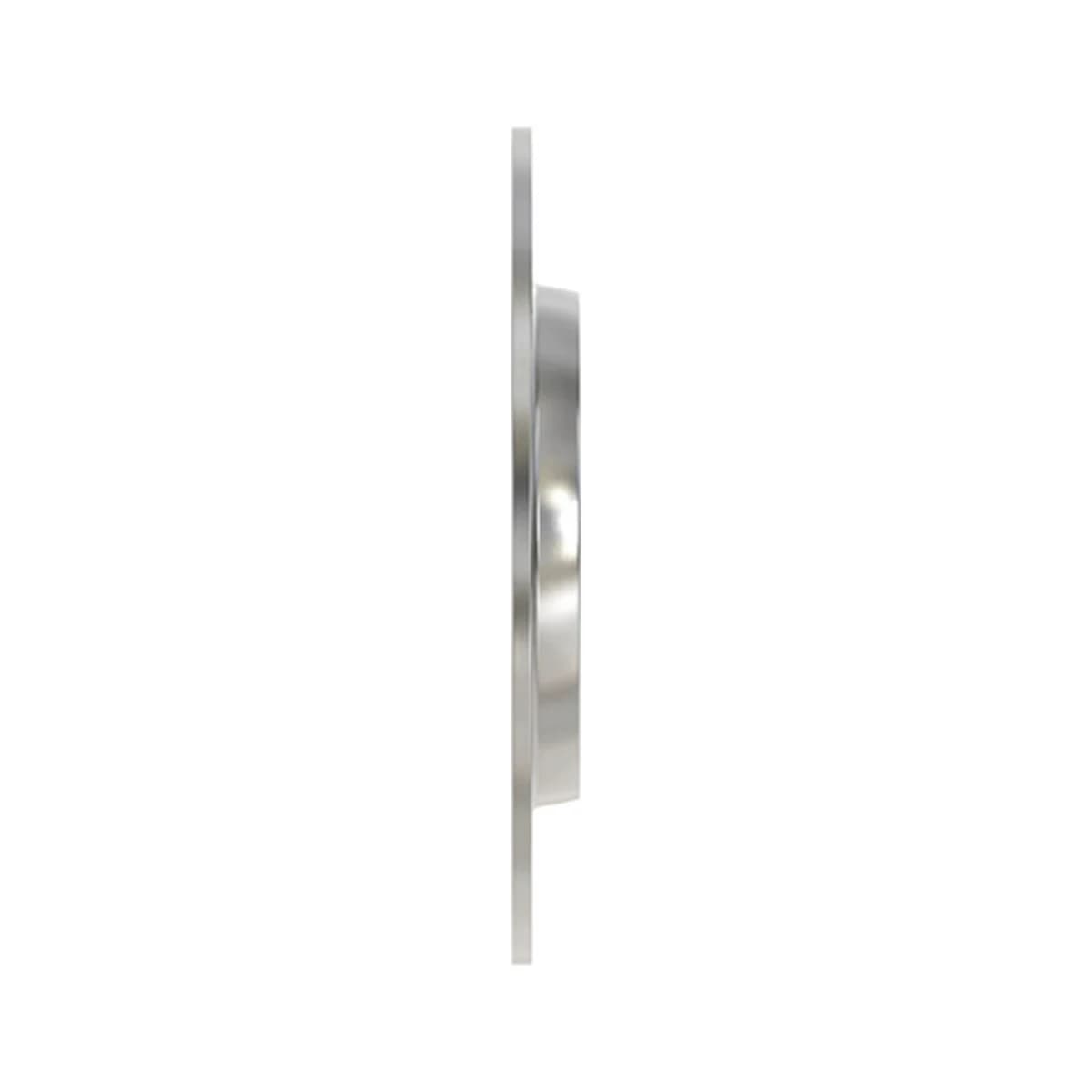
FFP-JD-R01159
4-Hole Flanged Bearing Housing for John Deere - Replaces OEM H174410
Aftermarket 4-hole flanged bearing housing replacing John Deere OEM H174410. Supplier-listed combine applications are available; confirm model and serial details with your quote.
FFP-JD-R01230
Concave Corner for John Deere - Replaces OEM AXE59657
Quote-only replacement part for OEM AXE59657. Confirm final fitment with your model or original part number.

JD5030
Pulley for John Deere - Replaces OEM H161415
Quote-only replacement part for OEM H161415. Confirm final fitment with your model or original part number.
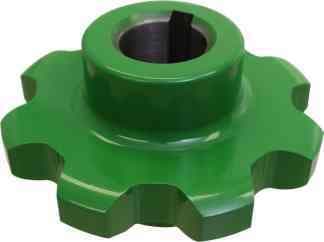
JD5289
Sprocket for John Deere - Replaces OEM H164796
Quote-only replacement part for OEM H164796. Confirm final fitment with your model or original part number.
FFP-JD-R01317
Bushing for John Deere - Replaces OEM HXE11049
Quote-only replacement part for OEM HXE11049. Confirm final fitment with your model or original part number.
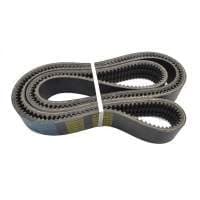
JD5508
Belt for John Deere - Replaces OEM H229019
Quote-only replacement part for OEM H229019. Confirm final fitment with your model or original part number.
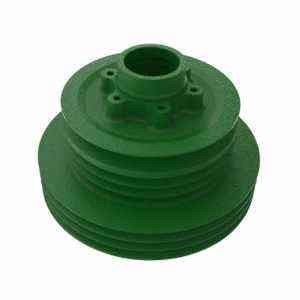
FFP-JD-R01252
Drive Pulley for John Deere - Replaces OEM H211582
Quote-only replacement part for OEM H211582. Confirm final fitment with your model or original part number.